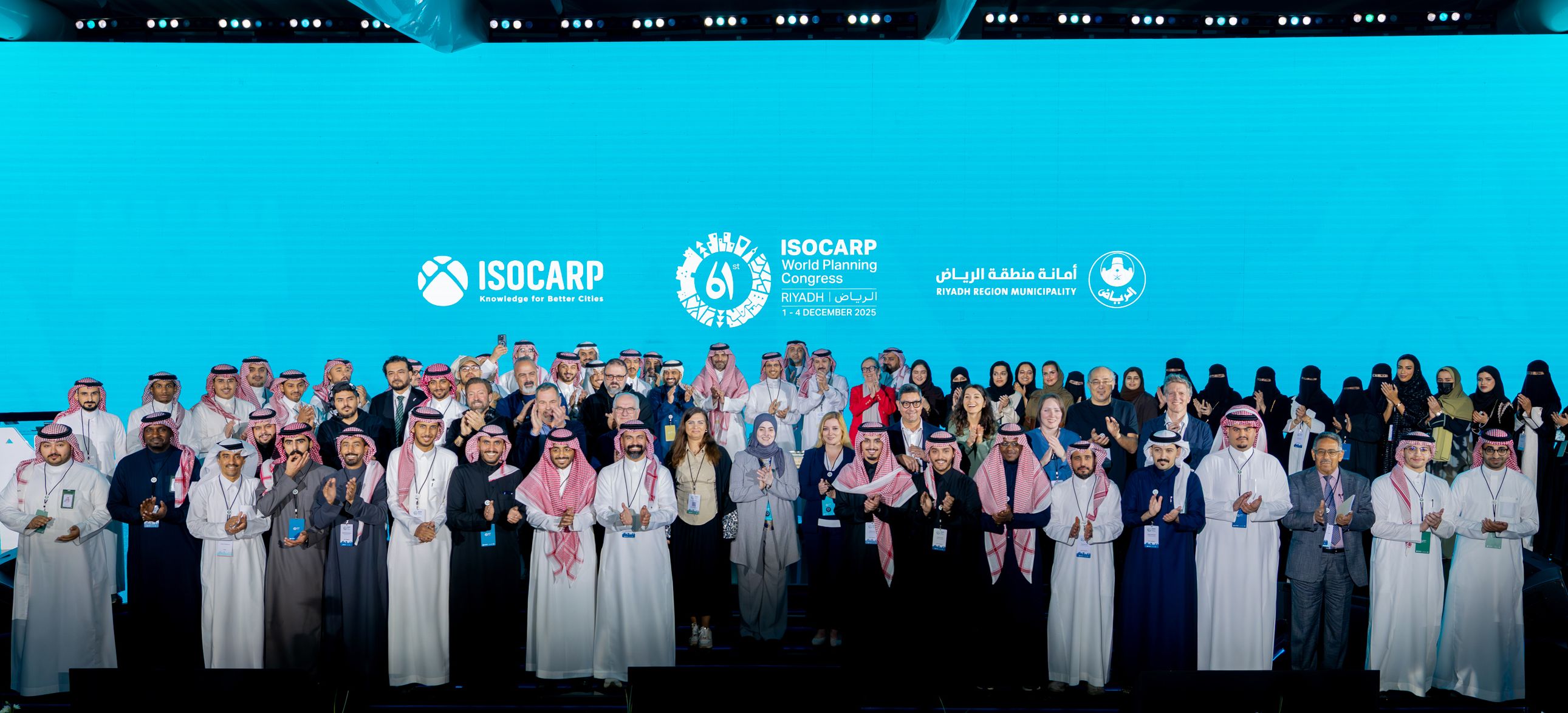
The 61st ISOCARP World Planning Congress has officially concluded, marking a defining milestone for the global planning community. From December 1–4, 2025, planners, policymakers, and innovators from across the globe gathered in Riyadh, Saudi Arabia, under the theme “Cities & Regions In Action: Planning Pathways To Resilience And Quality Of Life.”
Participants transformed ideas into practical pathways. The discussions in Riyadh demonstrated the power of international cooperation and professional commitment to address urgent urban challenges.
To our speakers, partners, and attendees, we offer our sincere gratitude. Your expertise and engagement have set a new direction for urban resilience and improved quality of life worldwide.
To our Congress host, Riyadh Region Municipality (RRM),we extend our sincere appreciation for the strong partnership that made this Congress such a success. Thank you for your generosity and commitment. We look forward to continuing and strengthening our collaboration well beyond the Congress.
Keynote Plenaries: Access exclusive recordings of the plenary sessions that defined the Congress.
The Riyadh Declaration: The end of the 61st WPC declaration and call to action for the planning world.
61st ISOCARP World Planning Congress Proceedings: Explore the publication, which contains research papers alongside case study reports presented during the Congress.
ISOCARP is more than an annual gathering. It is a global community of planners that is connected throughout the year by shared values and a commitment to better cities and regions.
By becoming a member of ISOCARP, you gain access to an international network, professional publications, awards programs, and opportunities to engage in Congresses, working groups, and exchanges worldwide. We warmly invite you to join the Society and be part of a community that learns together and leads together.
 Prof Greg Clark Prof Greg ClarkSenior Advisor on Cities, Regions, and Urban Futures Cities, Regions, and Urban Futures Urban Futures Cities, Regions, a n |  Managing Director, Geografia Pty Ltd Managing Director, Geografia Pty Ltd Ltd Ltd Ltd |  Lead of Sustainable Urban Development Portfolio, United Nations Economic and Social Commission for Western Asia (UNESCWA) |  Bartlett Professor of Cities and Regions, Centre for Advanced Spatial Analysis, University College London (UNESCWA) |  Professor Emeritus in the Department of City and Regional Planning at Yıldız Technical University, Türkiye University, Türkiye University, Türkiye |
Participants can expect a dynamic program, featuring a variety of research paper sessions, workshops, special sessions, and keynote presentations. These will delve into five key thematic tracks: sustainable urban growth in a world of crises, the impact of the digital age on urban economies, adaptation to extreme climatic conditions, cultural identity and inclusive urban transformation, and the governance of agile cities. The congress will also highlight innovative approaches to planning and governance, with a focus on enhancing the quality of life and resilience in cities and regions worldwide.
In addition to the technical sessions, the congress will provide a unique opportunity for site visits in Riyadh, offering firsthand insights into the city's transformative urban initiatives. Special sessions will cover topics like AI in planning, cities in action, and the role of Riyadh in shaping future urban development. Attendees will also engage with key thought leaders in urban planning through a series of plenary sessions and networking events, including the opening reception and gala dinner.
The Congress offers a rich program that not only offers cutting-edge insights into urban planning but also fosters collaboration and knowledge-sharing among global experts.
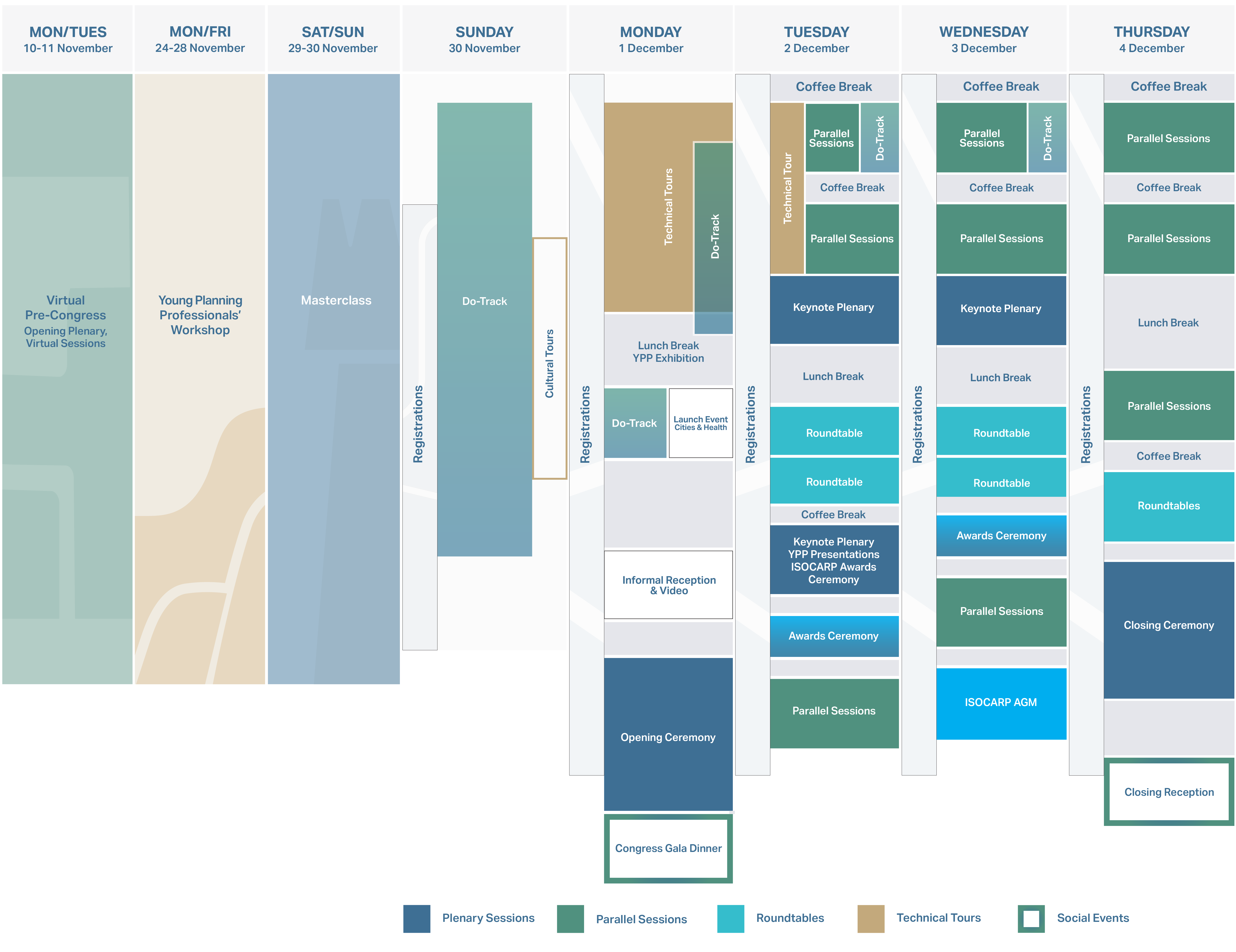
**This is a tentative Congress Programme and not the final version.
Cities are at the frontline of response to multiple crises that the contemporary world faces, which, if managed well, could open up tremendous possible futures for the way we plan, manage, and govern cities. As a home for already more than half of the world’s population, centers of innovation, magnets of talent, and locus of economic productivity, cities are uniquely placed to reflect on the quality of life, address well-being, and prototype solutions to global problems, capturing advances in Artificial Intelligence for the benefit of all people. At the same time, cities are called to lead the response to the climate crisis through localizing global frames of reference towards urban resilience.
At this crucial point, the global urban planning community and associated disciplines are rethinking processes, urban development models, and planning across scales to forge new pathways for cities to adapt to the convergence of crises and take on opportunities for a better quality of life for present and future generations. Cities and regions worldwide are putting strategies and resources, learning from peer networks, and prototyping new ways of planning and governing to accelerate implementation and act now.
At the 2025 World Planning Congress, ISOCARP calls on "Cities & Regions in Action: Planning Pathways to Resilience and Quality of Life," to analyze, discuss, and search for better pathways for urban and regional planning aiming at improving the quality of life of citizens beyond the current time of volatility, uncertainty, complexity, and ambiguity of crisis convergence and building resilience. The Congress also presents an opportunity to explore the possibilities of urban development for dynamic cities, reflect on alternative ways of planning yet at the same time think collectively on scalable solutions to the similar challenges that all cities and regions around the globe are called to face.